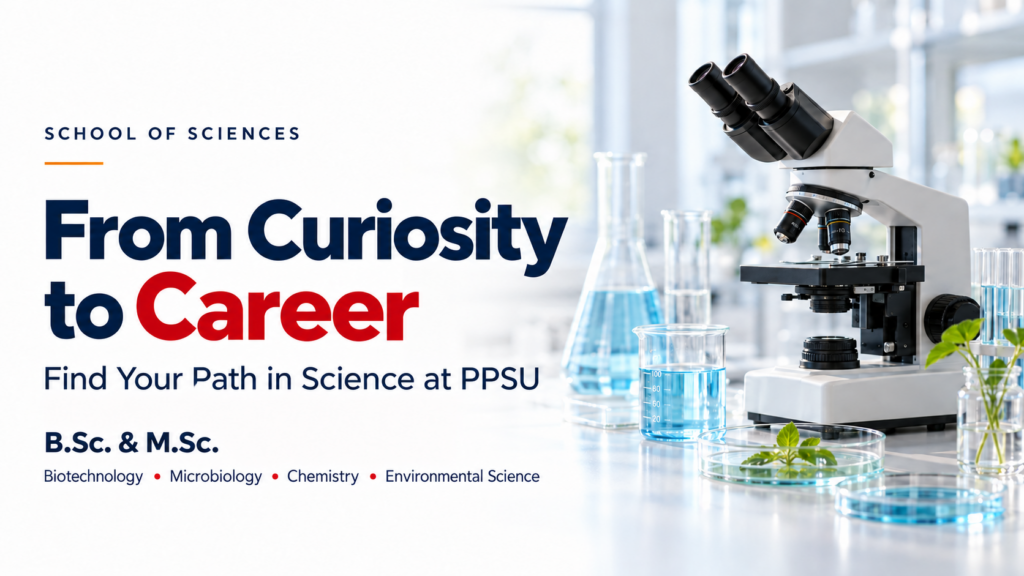
Do you enjoy understanding how living cells work, investigating chemical reactions or finding solutions to pollution? A science degree can help you turn that curiosity into practical knowledge. The first step is choosing a subject that matches the questions you want to explore—and the kind of work you would like to do.
At the School of Sciences, P P Savani University (PPSU), students can explore undergraduate, integrated postgraduate and postgraduate pathways in biological, chemical and environmental sciences. This guide explains the differences so you can make a more informed choice after Class 12 or graduation.
Start with your interests rather than the course name
Science subjects often overlap, but they approach problems differently. Biotechnology examines how biological systems can be used in applications such as agriculture and industry. Microbiology focuses on microorganisms and their behaviour. Chemistry studies substances, reactions and analytical methods. Environmental Science brings together field investigation and laboratory work to understand environmental challenges.
Think about the activities you enjoy: working with biological samples, analysing materials, studying microbial growth or collecting environmental data. Your preference can help you narrow the options before comparing course structures and entry requirements.
Which undergraduate science course suits you
B.Sc. Honours in Biotechnology
Biotechnology connects biology with practical applications. Students explore areas such as molecular biology, genetics, biochemistry and laboratory science. It can suit you if you are curious about cells and genes and want to understand how biological processes contribute to research, agriculture and industrial production.
Possible starting points after graduation include laboratory assistance, bioprocess or production support, and quality assurance or quality control training. Specialised research careers commonly require postgraduate study and further experience.
B.Sc. Honours in Microbiology
Microbiology explores bacteria, fungi and other microorganisms, including their roles in food, pharmaceuticals, fermentation and the environment. It is a useful direction for students who enjoy careful laboratory work and want to understand how microbes affect everyday life.
Career pathways may include food and water testing, pharmaceutical quality-control training, fermentation support and microbiology laboratory assistance. Clinical roles may have additional qualification and registration requirements.
B.Sc. Honours in Chemistry
Chemistry can suit students who enjoy experiments, chemical reactions and understanding how materials behave. The programme develops a foundation in organic, inorganic, physical and analytical chemistry, alongside laboratory methods.
Graduates may explore trainee roles in analytical laboratories, production, quality testing, materials testing and research support. Building competence in measurement, documentation and safe laboratory practice is valuable across these settings.
B.Sc. Honours in Environmental Science
Environmental Science examines pollution, ecosystems, water and soil quality, sustainability and environmental management. It combines scientific analysis with questions about how people use and protect natural resources.
If you enjoy both fieldwork and laboratory investigation, this pathway may interest you. Potential directions include environmental monitoring, water-quality testing, waste-management support, field surveys and environmental consultancy assistance.
Understanding the B.Sc. and integrated M.Sc. pathways
PPSU offers four-year B.Sc. Honours degrees in Biotechnology, Microbiology, Chemistry and Environmental Science. The school also offers five-year integrated M.Sc. programmes in Biotechnology and Microbiology, beginning after Class 12 Science.
A B.Sc. Honours degree provides an undergraduate foundation from which you can consider work or eligible postgraduate study. An integrated M.Sc. offers a continuous undergraduate-to-postgraduate pathway for students who already want to pursue deeper study in Biotechnology or Microbiology. Compare the curriculum and progression rules, rather than choosing solely by course length.
Postgraduate options after graduation
For graduates looking to specialise, PPSU offers two-year M.Sc. programmes in Chemistry, Biotechnology, Microbiology, Environmental Science and Clinical Embryology. A relevant bachelor’s degree is generally required; eligible subjects and other admission conditions differ by programme.
M.Sc. Chemistry develops advanced analytical and experimental understanding. M.Sc. Biotechnology and M.Sc. Microbiology offer deeper study of biological systems and laboratory research. M.Sc. Environmental Science focuses on areas such as assessment, monitoring, pollution control and sustainability-related scientific work.
M.Sc. Clinical Embryology is a distinct option for eligible graduates interested in reproductive biology and assisted reproductive technology laboratory science. Before applying, ask about supervised training, laboratory postings and the competencies required for professional roles. The degree alone does not establish eligibility for independent embryologist practice.
What practical science learning looks like at PPSU
The School of Sciences describes learning through practical classes, projects, internships, dissertations and research or industrial training, with requirements varying by programme. These experiences help students connect scientific concepts with observation, measurement and interpretation.
Facilities listed in the school guide include Molecular Biology, Microbiology and Plant Tissue Culture laboratories, along with a Central Instrumentation Facility. The equipment described includes PCR thermal cyclers, UV-visible spectrophotometers, camera-fitted microscopes, gel documentation systems and laminar airflow equipment.
For a prospective student, the useful question is how these facilities connect to your course. During a campus visit, ask which practicals you will undertake, how instrument training is organised and what support is available for projects and dissertations.
Industry exposure and career preparation
The School of Sciences identifies collaborations or MoUs involving organisations such as Sun Pharma, Lupin, JB Chemicals, Godrej Industries and Candor IVF and Multispecialty Hospital. The school also reports placement examples involving UPL, Asian Paints, Reliance Industries, Metropolis and other organisations.
These examples provide context for the school’s industry engagement. Specific internships, laboratory postings and recruitment opportunities depend on departmental arrangements and employer requirements. Ask for recent programme-specific examples and focus on developing laboratory skills, scientific writing, data interpretation and communication alongside your degree.
How to choose your next step
Shortlist the subject that interests you, check the entry requirements and compare the syllabus with the work you hope to pursue. Ask the school about practical hours, project supervision, internship arrangements and progression to further study. If you are considering a regulated or clinical career, clarify the additional qualifications and professional requirements early.
For undergraduate and integrated science programmes, 10+2 Science from a recognised board is the starting qualification. Exact subject combinations and current admission conditions should be checked for your selected programme. Postgraduate applicants should confirm that their bachelor’s degree meets the relevant requirements.
Explore the School of Sciences at PPSU
A good science course should give you opportunities to ask better questions, test ideas carefully and explain what the evidence shows. Explore the School of Sciences at P P Savani University to find a pathway that fits your interests and academic goals.
School website: https://www.ppsu.ac.in/school-of-sciences/
Apply online: https://admissions.ppsu.ac.in/
Admission helpline: +91 7778879189
Email: admission@ppsu.ac.in
Campus: P P Savani University, NH48, near GETCO, Dhamdod Village, Kosamba, Surat, Gujarat 394125.